
In our Winter Newsletter 2023 we publish two longer interviews with our members and partners in Iraq about their work and experience in the field as well as an update about current attempts to deport Yazidi refugees from Germany.
You and download the newsletter here and as always we kindly ask you to keep on supporting our work.
 Dear supporters and friends,
Next summer will mark the tenth anniversary of the unspeakable massacres committed by the Islamic State against Yazidis in Iraq in 2014. These crimes have now been classified, unanimously, by the German Bundestag as genocide. A decision that would certainly have been in the spirit of Raphael Lemkin, the man who almost single-handedly managed to get the then young United Nations to adopt the “Convention on the Prevention and Punishment of the Crime of Genocide” in the 1940s. The Polish-Jewish lawyer Lemkin, who fled the Nazis to the USA, regularly listened to the famous radio speeches of British Prime Minister Winston Churchill. In one, he described the “barbaric rampage of the Nazis” as “a crime without a name.” Lemkin not only wanted to give this crime a name, namely genocide, but also to ensure that something similar would never happen again.
The UN convention was correspondingly ambitious; it was less concerned with retrospectively recognizing crimes as genocides, but rather with making sure that the oft-used “never again” was translated into internationally valid law and that all those who those who are suspected of planning genocide can be preemptively targeted, because, as Lemkin once stated in a speech, genocide is even worse than war.
History goes on
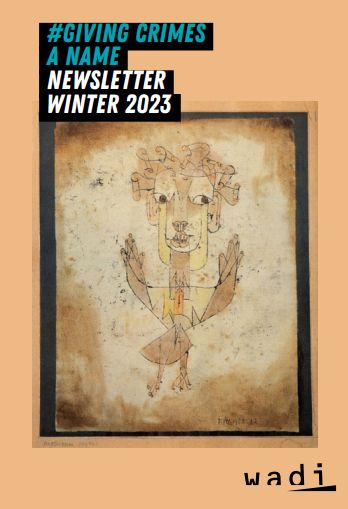
As is well known, history has continued since then as Walter Benjamin’s angel of history has always experienced it, namely as a “catastrophe that continually piles rubble on top of rubble and hurls it at his feet”. Whether in Cambodia, Rwanda or the Sinjar Mountains in Iraq, genocides took place again in full view of everyone, without anyone stopping them. Instead, after each of these crimes against humanity, there were only vows that something similar should never happen again. Vows that lasted exactly until the next one took place.

Picture of a Yazidi survivor of IS-capitivity
What also distinguishes the genocide from other massacres, wars and crimes is that the genocidal murderers, no matter what happens to them later, always emerge as victors. This fact is so terrible that one usually fights it off and represses it, and yet it has to be expressed again and again. This is also the case with the Yazidis in Iraq: the Islamic State has not achieved its goal, they have not been completely annihilated or destroyed, but there will no longer be a status quo ante for them. Hundreds of thousands now live in Europe and other Western countries, although most are still in so-called camps for internally displaced people in Kurdish northern Iraq. There is little hope for them of returning to the Sinjar Mountains, as various militias are still in charge there and large parts of the area remain in ruins.
Born and raised in camps
It’s hard to realize, but in the camp schools where our Yazidi employees work as part of Wadi’s anti-violence campaign, all primary school students were now born in the camps. They don’t know any other reality. And if nothing fundamental changes, which is unfortunately expected at the moment, then they will also be able to graduate from school as Internally Displaced Persons (IDP, as internally displaced persons are called in UN jargon) in these camp schools.
Incidentally, IDP is a neologism from the times when the UN Convention was adopted and referred to millions upon millions of people who had become homeless as a result of the “barbaric rampage of the Nazis” and were now wandering around Europe.

A school in Khanke Camp for Yazidi IDPs near Dohuk
The fate of these students is just one example among many of what it means to be a victim of genocide. We should also remember everyone who was abused as so-called sex slaves by IS fighters and those whose family members were exhumed in one of the countless mass graves in recent years.
As important as it is that what happened to them is now recognized as genocide by the German and other parliaments, it would have been even more important in 2014, when it was so clear what was going to happen, that the act should be carried out with everyone at the disposal means to prevent. Because this tragedy could have been prevented if only there had been the will to implement the Convention for the Prevention of Genocide. So the only consolation is that those who are caught and charged in Europe must expect high penalties. However, jurisprudence, which fortunately is now taking place again and again against them, is not reparation, because what was destroyed back then can never be even partially remedied.
Assisting to survive
It should be all the more important to support the survivors in every way possible, to help them in the truest sense: to survive and, wherever possible, to start a new life. This is not only the imperative of humanity, but also the strongest sign that we can send together to the perpetrators: You may have thought you won, but you did not succeed in destroying this group that you wanted to destroy . Every girl who returned from the clutches of ISIS and was taken back in, who now perhaps, and there are many such examples, goes to college, opens a hair salon or helps others, is a victory over those who wanted to destroy her. Our partner organization in Dohuk, the Jinda Center, has helped hundreds of girls with their reintegration, most recently in the now successful recycling center in the Khabatoo camp, just as other organizations have done the same with hundreds of other girls.

Such small success stories should not hide the fact that the fate of the Yazidis is slowly but surely being forgotten internationally. Other disasters continually pile up rubble on top of rubble and dominate the headlines and we are often asked, almost astonished: What, hundreds of thousands of them are still living in camps? Yes, they do, and the fact that this is forgotten can unfortunately be seen as another and late victory for those who wanted to wipe them out back then.
What is happening in Germany these days is just as frightening: Yazidis who had made it to Germany as refugees at the time and were only tolerated under Section 51 or Section 53 of immigration law are increasingly receiving deportation notices. The first ones were even “deported” to Iraq against their will, as it is called in the cold official language. Tens of thousands of people who could also be affected by such decisions are watching this development with growing horror, and Yazidi organizations have sounded the alarm, some even organizing a hunger strike in Berlin.
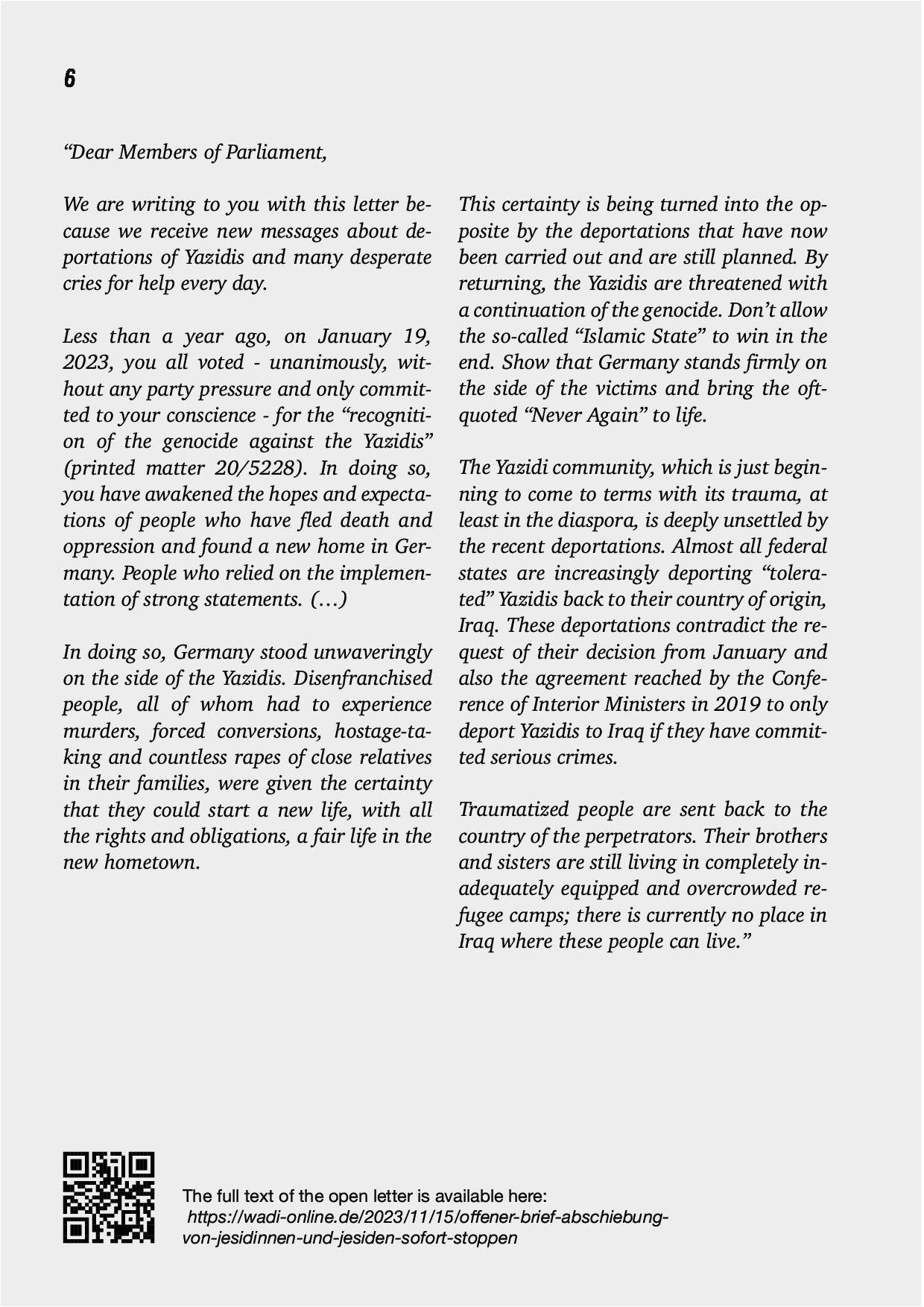
We too couldn’t believe our eyes or ears when we found out about these decisions, and then we took action together with other organizations and individuals. Together we wrote an open letter to all members of the German Bundestag to remind them that just a few months ago they had recognized the crimes of IS as genocide. Here are some excerpts that speak for themselves:
“Never again?”
We hope that this letter, supported by many well-known initial signatories, will have an impact and we will continue to do everything we can to prevent further deportations.
The letter concludes with the following words: “Let us all show together that Germany is no longer the country for which the legal term of genocide was found, but a country that stands on the side of the weak and those in need of protection.”
That is the minimum that could be expected or hoped for. After all, “never again” isn’t far off. These days there are again increasing warnings that there could be another threat of genocide in Sudan, where a bloody civil war has been raging for months and from which seven million people have fled so far, namely in the Darfur region – carried out by the successors of the notorious Janjaweed. Militia groups there have previously committed such massacres and crimes against civilians that prompted the International Criminal Court to file charges of alleged genocide.
This is the bitter reality in the region where we have been working for over thirty years. There are many reasons why such crimes keep happening. One thing is certain: to this day, far too little is remembered about what happened in the past. That’s exactly why we support various projects that deal with remembering and coming to terms with the terrible crimes of the Saddam regime in Iraq. Most recently, we were able to design a “memory trail” through Halabja together with our local partners, which will be inaugurated next year. This time only our employees from Kurdistan and Iraq will have their say. We had a lengthy conversation with two of our teams and translated this for you.
This impressively expresses the difficult conditions under which the work of Wadi and our partner organizations takes place on site, but also that in the midst of all the horror there is hope, change is possible and giving up is not an option.
As we write year after year, this is our maxim, and in 2023 we were able to remain true to it, of course thanks to your solidarity support, and we want to do the same next year.
Please support us with your donation
On behalf of all of our employees, I would like to thank you very much for your help and wish you a happy holiday and a happy new year.
Thomas von der Osten-Sacken
– Director
 Wadi
Wadi 
