
As the tenth anniversary of the genocide against the Yazidis in Iraq nears, PRO ASYL and Wadi e.V. are calling for the ‘right to remain’ for Yazidis in Germany. The victims of the genocide recognized by the Bundestag need security. The first step; a nationwide deportation stoppage.
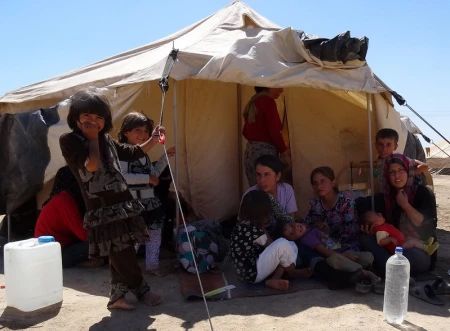
Yazidi IDPs in Dohuk 2014, Picture: Wadi e. V.
“No victims of genocide should be deported from Germany. The Yazidis need security and the right to stay here. Instead of granting the survivors of this genocide (which has been recognized by the Bundestag) this security, they are instead threatened with deportation. Not just any deportation, but back to the place where the genocide and incalculable violence against them took place. A nationwide deportation stop must finally be decided,” says Karl Kopp, managing director of PRO ASYL.
Even if no new deportations are currently taking place, Yazidis have been shown that they cannot trust that they will have any prospects in Germany. In Bavaria, for example, Iraqi refugees, including Yazidis, are systematically deprived of their ‘tolerance’ , a subsidiary level to full asylum that is part of the German asylum process. This means they lose their work permit and also the opportunity to live in their own apartment. And in other federal states, Yazidis are also put under pressure by the authorities and are threatened with sanctions such as a work ban and reductions in benefits.
Refugee camps in Iraq are to be evacuated
In view of the current developments in Iraq, a stop to deportations is long overdue: the situation for Yazidis has worsened in the last few weeks. The Iraqi government wants tens of thousands of Yazidis to leave the refugee camps in northern Iraq – without there being a safe place for them.
In concrete terms, this means: exactly ten years after the start of the genocide by IS, the Yazidis in Iraq are facing a completely uncertain future. It is unclear whether the camps will still receive basic supplies from August 2024 and whether the schools in the camps will reopen after the summer holidays. Baghdad’s decisions are already having a devastating impact on people.
“In principle, it would be good if the Yazidis could finally leave the camps and lead a normal life. But that’s exactly not what happens: The Yazidis cannot live safely in their native region of Sinjar in Iraq – nor in other regions of Iraq. Without these camps, they risk becoming homeless, destitute and defenseless, and they will also lose their schools and health care” emphasizes Shokh Mohammed from Wadi e.V.
Foreign Office: Future prospects remain difficult
The Foreign Office sees it similarly. In the current Iraq situation report (As of April 2024) it says: Despite efforts to improve the situation of the Yazidis, “future prospects in Sinjar remain difficult given challenging living conditions, the presence of non-state militias and a lack of implementation of the so-called Sinjar Agreement. The collective trauma of the genocide also often represents an obstacle to return for members of the community, especially to the traditional settlement areas and sites of IS crimes in Sinjar. The planned closure of IDP camps [IDP=Internally displaced persons] in the Kurdistan Region of Iraq on July 30, 2024 and the associated relocation to ‘informal camps’ with presumably poorer care would further aggravate the situation of the majority of Yazidis living in camps.”
Background: The situation for Yazidis in Iraq
Ten years ago, on August 3, 2014, the terrorist organization IS began abducting, enslaving, raping and killing Yazidi women, men and children. Since this massacre and even after the defeat of IS in 2017, most Yazidis are still living in refugee camps because they have no opportunity to return to their former lands and homes due to the precarious security situation in their home region of Sinjar (Shingal).
These IDP (Internally Displaced Persons) camps for Yazidis are located in areas of Iraq administered by the Kurdish regional government, but the Iraqi central government is largely responsible for their maintenance, and they have announced their intention to close the camps on July 30, 2024. The government in Baghdad wants partly with financial incentives, sometimes with pressure, to persuade the Yazidis to return to Sinjar.
Basma Aldikhi, employee of Wadi e.V. and Yazidi activist who supports women and girls abducted and abused by IS, observed: “The people in the camps are unwelcome everywhere, they have the feeling that they have been expelled from everywhere and neither from Kurdistan nor be accepted by Iraq.”
German federal states are not allowed to deport Yazidis into this completely unsafe situation. Their area of origin, Sinjar, is located in the strategically important border area between Iraq, Syria, Türkiye and Iran. Various state and non-state actors are fighting for power there, sometimes using armed force.
Another conflict is currently underway in northern Iraq Military offensive of the Turkish army against units of the Kurdistan Workers’ Party (PKK). Yazidis would also not be able to move to other areas of Iraq because without their community they are vulnerable to exclusion, discrimination and attacks.
The messy situation is described in detail in the documentation “Ten years after the genocide: On the situation of the Yazidis in Iraq,” which PRO ASYL and Wadi e.V. published in April 2024. The result: Without relevant security guarantees, Yazidi self-government, functioning law enforcement measures and compensation processes as well as clarification of the status of the disputed areas and demilitarization, the future of the Yazidis in Iraq cannot even begin to be discussed.
______________________________________________________________
Contact:

Pressestelle PRO ASYL, presse@proasyl.de, +49-69-24231430

Wadi e.V., Thomas von der Osten-Sacken, Geschäftsführer, thomas.osten-sacken@wadi-online.de, +49-151-56906002
 Wadi
Wadi 
