
Our new neswsletter is out. You can download it here and read about our projects to protect the environemnt, the situation of Yazidis in Iraq ten years after the genocide and the current work of our partners in Lesvos.
An excerpt from the introduction:
When it’s so hot on the weekend, you go to the more shady places and one of them is the Azadi (Freedom) Park in Suleymaniah, from which I’m writing you these lines. It’s also one of the places where you can see the changes that have taken place over the last decades, as if they were under a magnifying glass.
The large area near the old town was a huge military camp until 1991, when the people of Iraqi Kurdistan were able to free themselves from Saddam Hussein’s yoke. The troops with which the dictatorship carried out its brutal repression were stationed here. This is still remembered today by the so-called “Red Building” at the entrance to the park, a former headquarters of Saddam’s feared secret service, which was preserved as the Kurdish militias found it when they conquered it in the spring of 1991.
There, visitors can visit the torture chambers, the prison cells in which suspects were crammed together under inhumane conditions, but also learn a lot about the history of the resistance against the Saddam regime.
Iraq is also the country of mass graves: Since the fall of Saddam, new ones have been discovered everywhere in which the army and secret service buried civilians who were shot indiscriminately in the 1980s. A mass grave was even found on the grounds of Azadi Park, now commemorated by a somewhat outdated monument.
Just a few meters from this monument, a handicrafts market organized by women takes place on weekends, which brings us to the new Iraqi Kurdistan. Here, emphasis has recently been placed on organically grown products, and in countless projects – including ours – economic independence for women is being promoted. Young couples stroll past there, as do families and groups of women. Some people head to Luna Park, to ride pedal boats or roller coasters on an artificial lake.
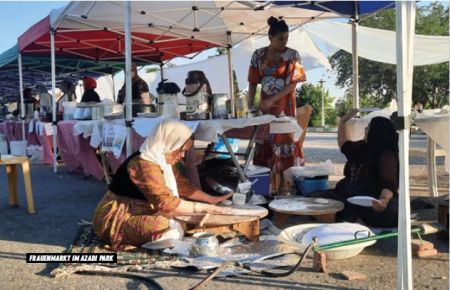
Women bazar in Azadi Park, Picture: Wadi e. V.
All of this is possible today because in 2000, two decades ago, the Kurdish administration at the time decided to turn this military site into a public park and give it this beautiful name. What was particularly progressive was that it was declared at the opening that so-called chaperones were not welcome in this park. Until then, there was no place for young couples who were not yet engaged and married to meet without supervision. An aunt, uncle or other family member always had to be there, and initially guards at the entrances to the park even checked whether visitors were adhering to this rule.
Such times are now a thing of the past, and even if morals are still quite strict, customs have noticeably relaxed. It was also unthinkable back then that women and men would sit mixed together in cafés; There was a strict separation between the family sector and places that were for men only. Today it is a common sight, not only in Azadi Park, to see groups of women sitting alone in cafes until late into the night.
There is a children’s festival a little further away, and there are also several playgrounds on site. For the little ones, the story told by the “Red Building” and the memorial to the mass grave is a long-gone past. Even those in their twenties in Suleymaniah can hardly imagine that fear and terror once reigned here, followed by civil war and bitter poverty. This is also a sign of how quickly changes can occur in this part of the world.
And especially in view of all the terrible reports that reach you every day from the Middle East, it is important to keep reminding yourself that changes for the better are possible, but they rarely make the headlines.
Of course, I could now draw a link to the miserable reality in the refugee camps, for example, which continue to exist everywhere and in which, ten years after the genocide by the Islamic State, hundreds of thousands of Yazidis continue to have to eke out a hopeless existence. I could also point out what it means to have to live in such a camp in these temperatures, but all of this seems very distant when you are spending an afternoon here in Azadi Park.
Below we would like to let three Wadi employees and partners in Iraq and Greece speak about some of the projects we support.
You can also find out more about all of our campaigns, programs and projects on our website at any time.
We wish you a nice summer and would like to thank you very much for your support so far – but not without pointing out that your donation makes or could make an important difference this year too.
Thomas v. Osten-Sacken
-Managing director
 Wadi
Wadi 
