During the first six month the Active Citizenship Campaign focused on enhancing the capacity and resilience of local stakeholders in the Kurdistan Regional Government (KRG) to foster citizenship and active engagement within their communities, particularly addressing children’s rights, youth empowerment, and environmental concerns.
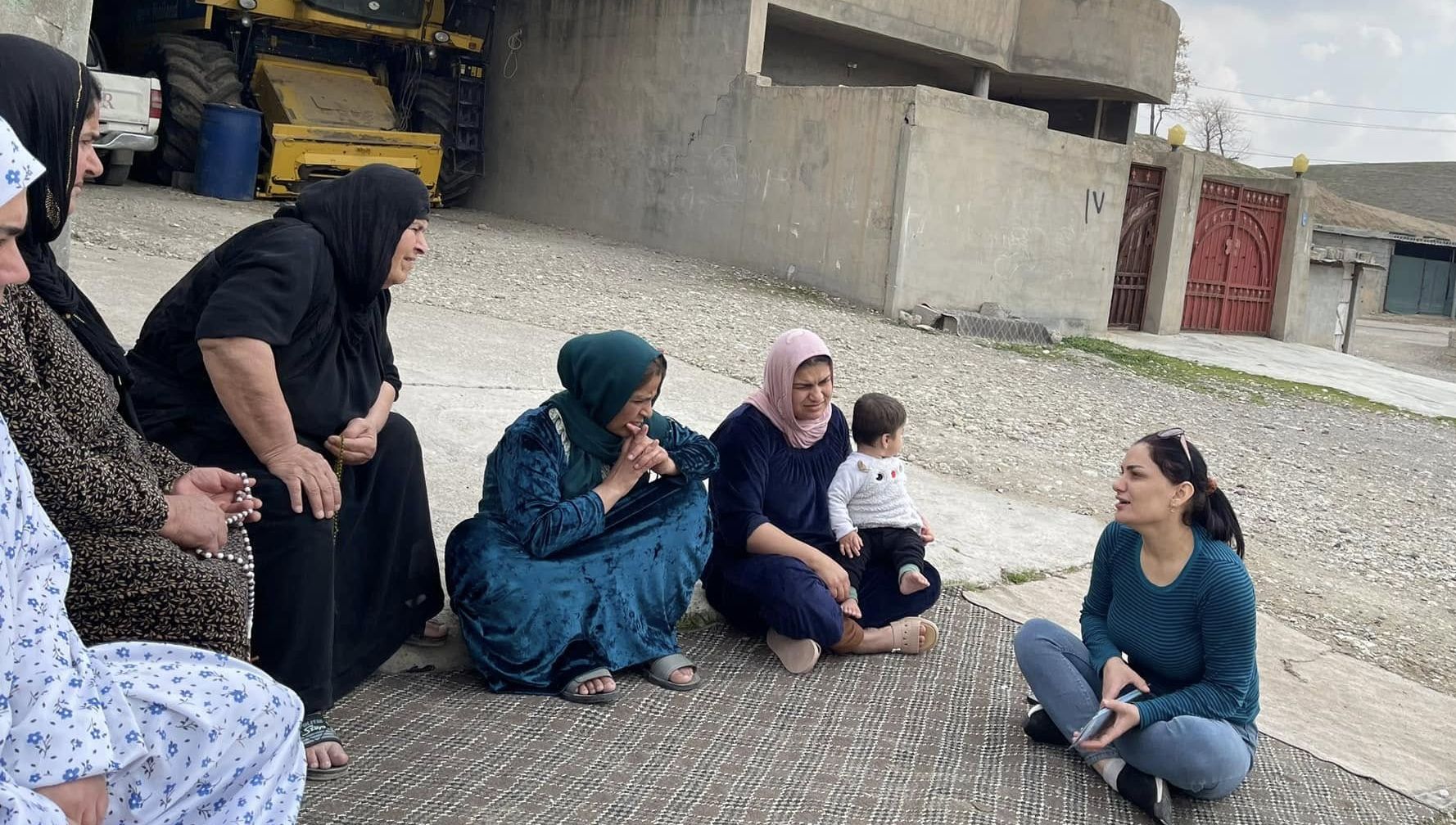
(Picture: Meeting with women in a Kurdish village)
Despite facing significant political and economic challenges, the project successfully engaged thousands of children and hundreds of women and young men through various activities, promoting social cohesion and media engagement to strengthen local discourse and cooperation.
Focusing on three key intersectional issues – children’s rights, youth empowerment, and environmental concerns, with a specific focus on youth engagement and media resonance in engaging youth – the project sought to use these topics as a springboard for broader conversations, intended to explore citizen engagement, effective cooperation, and youth-based approaches to resolving local issues. Wadi played a crucial role in coordinating activities among all implementing partners, providing technical capacity building and support to stakeholders, and overseeing the monitoring and evaluation of the project’s progress.
Environment
In the realm of environmental initiatives, Wadi’s partner NWE organized a series of seminars and a youth camping event focused on environmental issues. The seminars aimed to educate the citizens of Halabja about the importance of environmental conservation and the harmful effects of household chemical cleaners on both the environment and human health.


(Pictures: Environment activities of NWE in Halabja)
They also provided insights into alternative cleaning methods and highlighted the significance of using recycling centers for plastic waste disposal.
To promote an intersectional approach to the project, media partners KirkukNow, Radio Deng NWE, and Radio Dang (Kalar) collaborated with NWE Organization to either report on their efforts or gain a deeper understanding of local environmental challenges, which they then shared with their audiences.
Child rights
Schools and children’s rights serve as an excellent foundation for citizen-driven projects. These initiatives often highlight the existing deficiencies in local educational institutions and demonstrate the significant potential for positive change when teachers, parents, administrators, and students collaborate to tackle common challenges.
A recent example of this collaborative spirit occurred in Duhok, where our partner organization, Jinda, swiftly addressed the evolving needs of Yazidi refugees in the camps. Following the devastating ISIS attacks on Sinjar a decade ago, these individuals sought refuge in the camp, only to face a new crisis in August 2024 when the Baghdad government announced the defunding of the camp. This decision not only threatened their basic needs but also jeopardized their children’s education, as local schools were unprepared to accommodate them.
Acknowledging this urgent issue, Jinda, with logistical and technical support from Wadi, seized the opportunity to enhance citizen engagement, empowering local stakeholders to collectively communicate their situation to the media. The active citizenship promoted through this project aimed to build trust in local problem-solving, encouraging residents to stay in their communities and invest in their futures rather than resorting to migration.
Starting on June 1, 2024, the project collaborated with the Yazidi community in the Duhok camp to advocate for citizen-based solutions to the various challenges they faced.


The project’s media coverage, significantly amplified by our media partner KirkukNow, has been extensive, further enhancing the positive impact of this active citizen approach and giving a voice to the Yazidi community.
Jinda team also conducted a series of sessions for internally displaced persons (IDPs), primarily Yazidis, focusing on citizenship, tolerance, coexistence, and human rights awareness. In June 2024, the Baghdad government’s decision to stop funding Yazidi displacement camps caused significant panic among residents. Jinda held meetings in Khanke, Essian, and Sharia camps to address concerns about potential disruptions to education and forced returns to unsafe areas in Shingal. Many participants expressed fears about inadequate housing, security, and basic services in their home regions, as well as the risk of losing educational opportunities for their children.
Responses to the sessions were mixed; while some participants felt empowered and valued within the broader community, others expressed disappointment and renewed fears for their safety as Yazidis. The joint activities fostered some trust between communities, but challenges arose in reconciling new values with deeply rooted cultural norms. Concerns about losing cultural identity to host communities were also voiced. Jinda engaged with local officials, including the Director of Education in Simele, who opposed the camp closures due to instability in Shingal and the lack of alternatives. Many camp residents expressed a desire to emigrate rather than return without justice for past crimes.
In addition to the urgent situation in the Duhok camp, various child rights and youth empowerment initiatives have showcased the effectiveness of this approach. The playbus, a mobile playground from partner ADWI, travels to villages in the Ranya, Erbil, and Garmyan regions, offering children and youth play-based learning experiences on essential topics like children’s rights, civic engagement, environmental issues, and non-violent conflict resolution.


(Pictures: Playbus Activities)
To combat the widespread issue of corporal punishment, which is still legal and culturally accepted in the KRG, Wadi has led the “No to Violence” campaign since 2018. This initiative collaborates with local schools, parents, and students to promote non-violent disciplinary methods, maintaining authority without physical or psychological harm. Wadi also provided expertise to project partners focused on child rights. The campaign also includes awareness on the harms of female genital mutilation (FGM).
Media coverage has effectively highlighted the project’s core themes: active citizen responses to local issues, increased trust among stakeholders, and the success of youth engagement in decision-making. Empowered youth feel a stronger connection to their communities and are more likely to invest locally.
The child rights activities were implemented by several key partners: ADWI in Ranya, Garmian, and Erbil; Jinda in Duhok; WoLA, which provided legal awareness training in Sulaymaniyah focusing on young women and issues like early/forced marriage and family violence; and Human Network, which raised awareness about public health issues, including vaccination and women’s reproductive health. Each partner contributed unique expertise and perspectives to the project.
Rights awareness for youth
WoLA engaged female youth in schools by offering interactive awareness seminars at local girls’ schools in the Sulaymaniyah area. These seminars addressed legal issues faced by young women, including forced and early marriage, legal rights in marriage, financial rights, domestic violence rights, and more recently, social media rights, as well as efforts to combat honor killings linked to social media blackmail and deepfakes.
In conjunction with the International Day for the Elimination of Violence Against Women on November 25, WoLA organized a 16-day activism campaign that facilitated discussions on these topics, allowing students to learn about existing laws related to violence, express their concerns, and access resources for immediate assistance.
The seminars aimed to educate students about relevant laws and the negative consequences of these issues, fostering open dialogue and encouraging them to share their experiences. However, WoLA encountered significant logistical challenges, such as schedule changes due to student exams and national holidays, as well as last-minute school cancellations. To address these issues, they focused on networking by meeting with key stakeholders in the education department and communicating with school principals to strengthen relationships.
This experience underscored the ongoing need for an ‘active citizenship’ and network-building approach, emphasizing the importance of maintaining strong connections among municipal, organizational, and local structures to effectively achieve project objectives and overcome challenges. Overall, feedback from students and school staff was overwhelmingly positive, with participating schools expressing a strong interest in continuing these seminars in 2025, recognizing their relevance to students’ daily lives.


(Pictures: Health awareness courses conducted by Human Network)
Human Network, a new partner of Wadi, initially collaborated with schools and local youth to provide general health information aimed at improving community health outcomes. Topics included vaccination, smoking cessation, and nutrition. In the project’s second three months, this partner focused on women’s health, discussing topics such as women’s cycles and what constitutes a healthy menstrual cycle, along with other relevant health issues. They delivered dynamic and engaging seminars that encouraged youth participants to ask questions, share their experiences, and express their opinions.
Media
Media and youth engagement are vital components that enhance citizen and youth empowerment, particularly in Northern Iraq, where press freedom is limited. Citizen journalism, where non-professionals produce news, democratizes information flow and encourages active participation in public discourse. For 15 years, Wadi has supported this approach, investing in local citizen-led media and training citizen journalists to foster community discussions and independent media.
Kirkuk Now aims to strengthen the concept of citizenship in Iraq by leveraging local media to promote civic engagement and inclusivity. Their content addresses critical issues such as youth empowerment, public service deficiencies, minority challenges, climate change, women’s rights, and voting rights.
By raising awareness and encouraging participation, especially among women and youth, Kirkuk Now seeks to advocate for fundamental rights, including access to education and healthcare, particularly in light of upcoming parliamentary elections.
As part of their collaborative efforts, Kirkuk Now and ADWI created a voter education video for first-time voters ahead of the Kurdistan Region’s parliamentary elections. However, the political landscape remains complex, with disputes among winning parties creating a legal vacuum and disrupting education due to teacher boycotts over unpaid salaries.
In the project’s second half, Kirkuk Now focused on the importance of youth and women’s political participation, reporting on the challenges faced by internally displaced persons (IDPs) and abducted Yazidis.
Their work highlighted the need for citizen participation in governance and transparency in budget allocation. Despite challenges such as limited access to authorities and security concerns, Kirkuk Now achieved significant success, including a report that led to the government approving a national ID for a Christian woman denied due to her religion. This illustrates the crucial role of media in addressing local issues and fostering cooperation between NGOs and government entities.
Radio Dang in Kalar is also involved in the project, operating as a citizen journalist-run radio station that aims to raise awareness and foster discussions on local and regional issues.
The station focuses on making topics such as environmental degradation, women’s rights, and societal participation engaging and accessible to youth. Throughout the project, Radio Dang produced segments featuring one or more guests in panel discussions, beginning with a fact-based introduction. These segments were broadcast on local radio and streamed live on Facebook and Instagram, encouraging audience questions and participation.
The topics addressed included the dialogue between government and civil society, expectations for changes in parliamentary elections, the poor infrastructure of schools and youth services, strategies for local councils to invest in education, the media’s role in society and democracy, the status of women and human rights in the Kalar area, the relationship between civil society and municipal councils, the reality of groundwater pollution in Garmian, women’s involvement in environmental issues, actionable steps to combat pollution, and the impact of education on women’s rights.
This project is supported by the Foreign Ministry of the Netherlands, Jolibelle Foundation and Wadi private donations.
 Wadi
Wadi 
