
Wadi’s playbusses bring joy and hope to thousands of kids in remote and neglected areas of Iraqi-Kurdistan … since almost twenty years.
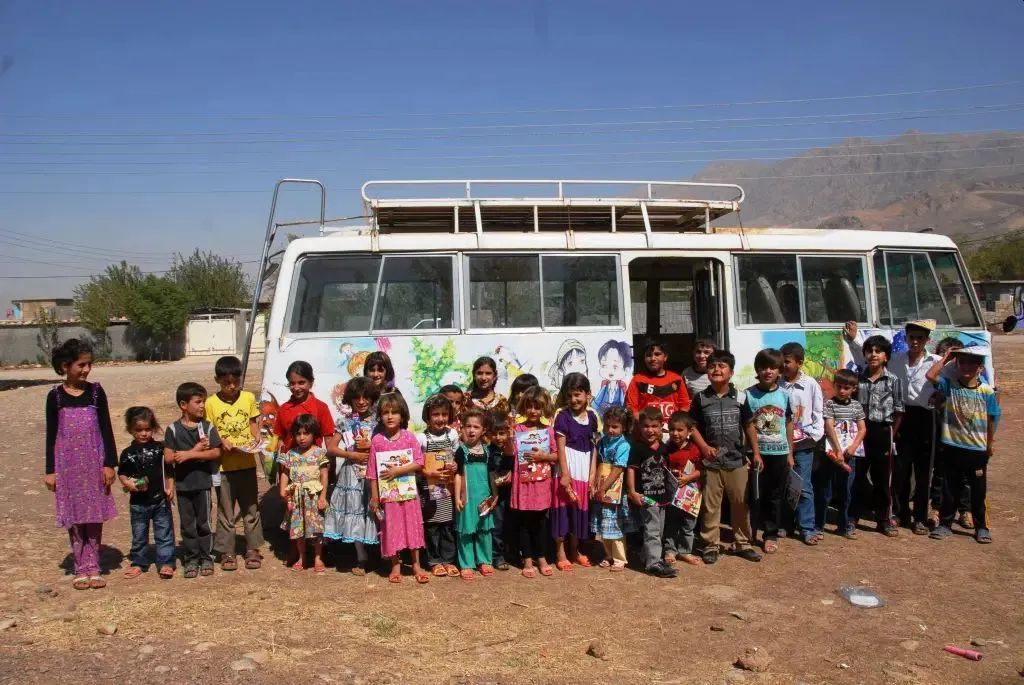
Two women and one man, social workers and nurses, form a crew. Four days a week they set out to poor villages in the Hauraman, Garmyan and Erbil regions in which people continue to suffer from the effects of the poison gas attacks conducted by the Saddam regime. The past was violent here, and its legacy shapes the present. The elder generation has many survivors of torture and war trauma. Almost none of them have been treated, neither physically nor mentally. Children in this environment have a hard life and few opportunities.
Wherever they go, the buses are joyfully anticipated at each of their daily changing destinations. Anyone who witnesses this gleeful reaction will understand instantly: These kids are not often the centre of attention, and their right to play is not a priority.
Having fun, living a carefree life, is not a given for these children. Playgrounds do not exist. Once, a boy told our team members he believed that only kids on TV could have such nice toys.


Travelling in a neglected region
There are several regions, including the rural surroundings of the buzzing capital Erbil, that are more neglected than others by the regional government, despite the great needs there. They lack sufficient infrastructure, medical care and health awareness. Elderly people are still suffering from physical and psychological late effects of the poison gas attacks and other genocidal actions perpetrated by the Saddam regime.
When the playbus is touring through the area, it is an immediate eyecatcher. Its exterior is covered with pictures drawn by the children and quotations from the Children’s Rights convention.

Apart from numerous games, painting supplies and musical instruments, the bus contains sports and play equipment, and a small children’s library. As long as the bus is in a village, the children may use everything they like. Things can be borrowed and returned the next time. The program includes organized games, races and reading children’s books. All children then gather around the reader who is usually presenting a fairytale, supported with illustrations.
This project is implemented in co-operatiion with our partner ADWI and you can follow it on their FB-page
2000 children are desperately waiting for the Wadi playbus
The aim of this project is to support the development of these multiply disadvantaged children through play-based learning . Experiences are gathered and analyzed in order to optimize the concept and the practical implementation of the program.
The teams also focus on environmental education and offer games to learn about recycling and how to save water and energy. These activities are embedded in Wadi’s Keep Kurdistan Green Campaign. The children love planting and greening of schools and other public places.
(Video: A day with the playbus team)
One day per week is devoted to the team’s planning and evaluation.
During its stays in the villages, the team gets a valuable insight into the specific problems and needs of the various places. This information is important for planning new projects. If necessary, the regional administration is informed of grievances, or contact is made with the press and media. Acute cases, such as domestic violence, can be dealt with and discussed individually. If necessary, women receive legal advice or are referred to women’s protection initiatives.
The play bus program is embedded in the No Violence Campaign, which Wadi has been running successfully at numerous schools in the region for several years.
Like all Wadi projects, the program is characterized by the fact that places are visited not just once, but at regular intervals. The teams remain in contact with the local people. This builds trust and creates an atmosphere that, after a while, makes it possible to discuss largely taboo topics such as sexuality and violence. A playbus can take care of about 50 villages with up to 2,000 children each year.
More support is needed
No wonder the playbus is continuously in need of new toys. The borrowing system and also the free distribution of small things like painting sheets or pens is an important feature of the project.


Another important strategy of the project is its quest for support and inclusion of local authorities. Several collaborations with schools have taken place, and dedicated individuals made contributions. By including stakeholders of society, awareness of the needs of children to play and learn through fun will grow. A next goal is the organization of a “Children’s Festival” in which several villages could participate.
Again and again the playbus team is confronted with the concerns and wishes of the villagers, whether it is a demand for a computer course or the request to the playbus to offer also something to eat or provide clothes. In villages where there is no school, the desire for a student transport service is all too easy to understand. “I dreamt ,” an eight year old girl once confessed to the playbus team “that you remain in our village and live here with us.”
Kurdish TV KNN reports about the Playbus in Rania
Please support this important project with your donation
The playbuses are supportet by Roselo Foundation and the German Consulate in Arbil
 Wadi
Wadi 
