
Thousands of Yazidis in Germany are threatened with deportation to Iraq. This open letter to all members of the German Bundestag, initiated by Wadi, demands an immediate stop to deportations. It has also been published on Change.org. Please consider supporting it with your signature.
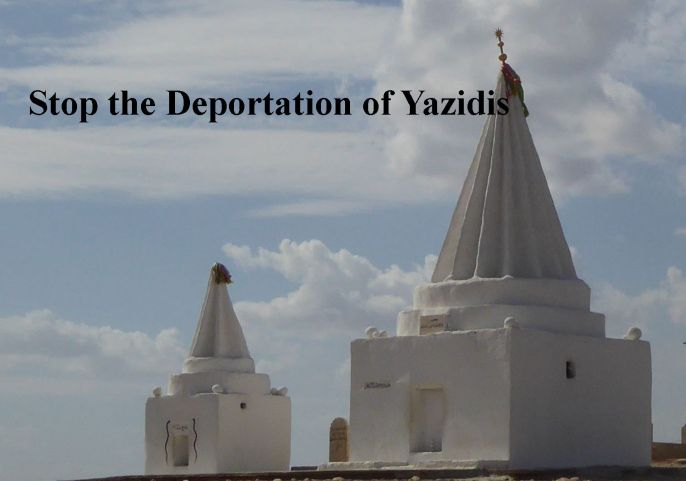
Open Letter to Members of the Bundestag: Immediately Stop the Deportation of Yazidis and Prevent a Continuation of the Genocide
Dear Members of Parliament,
We are writing to you today as we receive daily reports of deportations of Yazidis and many desperate cries for help.
Less than a year ago, on January 19, 2023, you all voted unanimously, without any party pressure and only bound by your conscience, to “recognize the genocide against the Yazidis” (Drucksache 20/5228). This gave hope and expectations to people who had fled death and oppression and found a new home in Germany. People who had relied on the implementation of strong statements.
We would like to remind you of the Bundestag session at that time and some of the many supportive statements:
The CSU MP Dr. Jonas Geissler spoke of Germany as the second home for the Yazidis. In the direction of the IS perpetrators, he said: “If you wanted to take your world from them, so we give them ours.”
The MP from BÜNDNIS 90/DIE GRÜNEN Max Lucks said:
“The largest Yazidi diaspora lives in Germany. This obliges us as the Bundestag to take action. Experienced traumas, the constant fear of not living in safety, the feeling that the world is not looking at the humanitarian situation of the Yazidis – with our initiative, we would like to draw a line under all of this.”
Some more Strong Statements that were spoken on January 19 2023:
The SPD MP Anika Klose emphasized that the Bundestag is now ensuring that what happened can never happen again and emphasized: “We are going on this difficult journey together.”
The FDP MP Peter Heidt (FDP) explained that “It is about helping a tormented people and enabling the tormented Yazidi community in the largest diaspora community to live without discrimination.”
Michael Brandt, MP for the CDU, emphasized at the time that “The Bundestag is deliberately taking on the obligation to stand by the Yazidi people – at all levels and permanently.”
All factions emphasized the special need for protection of Yazidis.
The concluding statement by Federal Foreign Minister Annalena Baerbock made the significance and scope of the recognition visible:
“The parliamentary decision stands for the whole country. Germany recognizes the genocide against the Yazidis.”
On the side of the Yazidis
Thus, Germany stood unshakably by the side of the Yazidis. It gave the certainty to people who had experienced murders, forced conversions, hostage-taking and numerous rapes of their closest relatives in their families, that they could start a new life, with all rights and obligations, a just life in their new homeland.
This promise of safety and a chance at a new life, has been destroyed into fear and uncertainty opposite by the deportations that have been carried out and are still planned. The Yazidis face the continuation of the genocide through their return.
Don’t allow the so-called “Islamic State” to win in the end. Show that Germany stands firmly on the side of the victims and that the oft-repeated “never again” actually means “never again”.
The Yazidi community, which is just beginning to come to terms with its trauma, at least in the diaspora, is deeply unsettled by the recent deportations. Almost all federal states are increasingly deporting “tolerated” Yazidis back to their country of origin, Iraq. These deportations contradict the request of their decision from January and also the agreement reached by the Conference of Interior Ministers in 2019 to only deport Yazidis to Iraq if they have committed serious crimes.
Back to the country of the perpetrators?
Traumatized people are sent back to the country of the perpetrators. Their brothers and sisters are still living in completely inadequately equipped and overcrowded refugee camps; there is currently no place in Iraq where these people can live. The reconstruction of Shingal, the area of origin of the Yazidis, which has also been promised by the federal government, has not even begun and just a few days ago another large Yazidi family was murdered there. A Yazidi man deported from Germany died on the street in Erbil less than 48 hours after his return.
The obviously planned and coordinated implementation of these deportations from almost all federal states is all the more surprising since these are almost exclusively people who are now well integrated. They are employed, go to school or, as individuals, are to be torn away from their family unit.
Two individual cases:
A young Yazidi woman is allowed to follow her family to Germany at the age of 17. Four years later, she has a one-year-old child and, as an adult, is an independent asylum case. Her right of residence is revoked because she cannot pursue a professional activity because of the child. She has to return to the perpetrators’ country with the small child. The rest of her family is allowed to stay, knowing full well that her daughter, sister and grandchild have little chance of survival in Iraq.
This is certainly not what you intended with your vote in January: to recognize the Yazidis as victims of genocide in order to immediately deport them back to the country of the genocide.
A young man has been working for 36 months of the last four years. During the recession that followed the Corona crisis, he lost his job, got a new job on his own and made an appointment with the immigration authorities to extend his work permit. When he entered, the police were waiting for him instead with permission to take him into deportation custody.
Lower Saxony does it differently
One federal state in particular shows that there is another way: Lower Saxony remains true to its promise that Yazidis are only to be deported if a serious crime has been committed. Here the talk of the new home is still filled with life and hope. As Nobel Peace Prize winner Nadia Murad said during her visit to the Bundestag:
“Germany is my second home, which is why you are also my representative.”
What applies to Nadia Murad applies to all Yazidis. They see Germany as their new home. They love this country and the opportunity to speak their language without persecution, to work without discriminatory restrictions against Yazidis, and to be able to live their own faith. They appreciate the benefits of democracy and freedom of expression, and they feel part of this country. This belief has been more than shattered. Around 300,000 Yazidis (25% of this population worldwide) live in Germany. Around 30,000 of them are at risk of deportation because of their restricted residence permit. In almost every family there is at least one person who is threatened with returning to the country of the perpetrators, a country for which the Foreign Office has issued a travel warning; a country to which the members of the Human Rights Committee of the German Bundestag cannot currently travel due to the tense situation. If security cannot be guaranteed for our well-protected parliamentarians, how can there be security for the people who are still viewed as infidels and “devil worshipers” by the Sunni majority population?
It takes political will
This is certainly not what you intended with your vote in January: to recognize the Yazidis as victims of genocide in order to immediately deport them back to the country of the genocide. On January 19th you stated that Germany stands on the side of the Yazidis. This also means that deportations to Iraq must stop immediately.
First of all, this requires political will. As a first step, the Federal Ministry of the Interior can impose a stop on deportations for Yazidis. If the federal states do not fulfill their obligation, then the federal government is called upon.
The Federal Republic has a strong parliament. Show this strength and give the Yazidis the right to stay. Show the government the way to ensure a real “never again”. Let us all show together that Germany is no longer the country for which the legal term of genocide was found, but a country that stands on the side of the weak and those in need of protection.
Please sign the open letter here.
____________________________________________________________________________
As first signatories, the following people and groups support this open letter.
(List listed alphabetically)
Aktion 3. Welt Saar e. V.
Andrea Johlige, MdL Die Linke, Brandenburg
Anne Retzlaff, AK Asyl Friedrichsdorf
Dr. Ali Khalaf 1. Vors. Ezidxan International Aid e.V.
Enno Stünkel, Celler Netzwerk gegen Antismitismus
Erzbischof Mor Julius Hanna Aydin, Syrisch Orthodoxe Aramäer Deutschland
Flüchtlingsrat Niedersachsen
GEA, Gesellschaft Ezidischer Akademiker e.V.
Prof. Dr. Gerhard Wegner. Niedersächsischer Landesbeauftragter gegen Antisemitismus und für den Schutz jüdischen Lebens
Gesellschaft für bedrohte Völker
Günther Burkhardt, PRO ASYL e. V.
Holger Geisler, Herausgeber Lalis Dialog (V.i.S.d.P)
Ilyas Yanc, 1.Vorsitzender Yezidisches Forum Oldenburg e.V.
Irfan Cakar, Rechtsanwalt
Ismet Nokta, Vorsitz Arche Noah e. V., CDU Münster
Jinda Organisation, Dohuk
Prof. Dr. Dr. Jan Ilhan Kizilhan, Psychologe,
Dr. Jochen Reidegeld, Friedensforscher
Josef Weidenholzer, ehemaliger MDEP, Präsident Volkshilfe Österreich
Jüdische Gemeinde Celle e.V.
Prof. Dr. Karin Stögener, Lehrstuhl für Soziologie, Universität Passau
Karl Kopp, PRO ASYL e.V.
Kurdische Gemeinde Deutschland e.V.
Landesverband der Eziden in Niedersachsen
Prof. Dr. Lars Rensmann, Lehrstuhl für Politikwissenschaft, Uni Passau
Rabbiner Maximilian Feldhake, Jüd. Gemeinde Celle
Necdal Disli, Rechtsanwalt
Dr. Remko Leemhuis, Direktor AJC Büro Berlin
Weihbischof Dr. Stefan Zekorn, Bischöflicher Beauftragter für die Weltkirche im Bistum Münster
Prof. Dr. Stephan Grigat, Centrum für Antisemitismus- & Rassismusstudien, Kath. Hochschule NRW
Telim Tolan, ehemaliger Vorsitzender Zentralrat der Yeziden in Deutschland (ZYD)
Wadi e.V., Verband für Krisenhilfe und solidarische Entwicklungszusammenarbeit
 Wadi
Wadi 
