This June, we’re kicking off a year-long campaign for citizenship alongside our partners. Starting with 30 days dedicated to children’s rights, because education is a right, not a privilege.
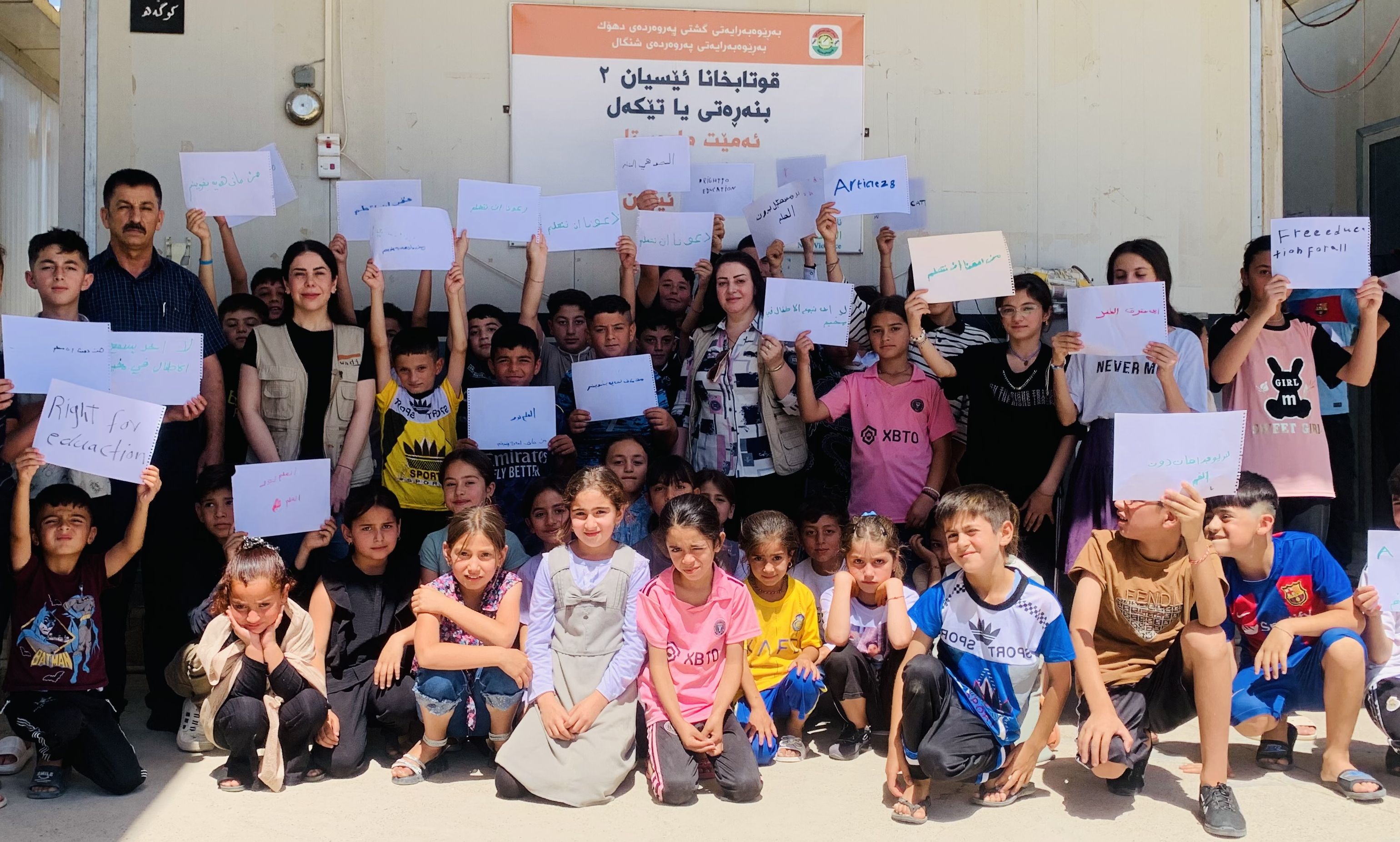
Students in a camp for Yazidi IDP demonstrate for their right to education
The Iraqi Government’s announcement of its intended defunding of refugee camps in July 2024 potentially threatens the safety of hundreds of Yazidi people. The Iraqi government also announced its intention to stop providing aid and withdraw governmental services in these camps. As a result, schools in the camp might no longer function after summer. People are nervous and frightened by this edict, especially Yazidi children in the camps, who are realizing that their access to schooling will also end with the closure of the camps. As it stands, they do not have access to local schools outside the camp structures. But the Convention on the Rights of the Child is clear: all children deserve an education. That’s why we’re saying that withholding education is violence.
This is just the beginning. We have a whole year of projects lined up, all focused on the concept of citizenship engagement, a term we call ‘active citizenship’ embodied by our partners on this project ADWI, Jinda, and Kirkuk Now. Our projects will take a mutli-disciplinary and intersectional approach to bring different facets of what it means and what it can mean to be a citizen, to be engaged for and with community and local municipal government. Projects include; citizen journalism, non-violent education, environmental engagement, working to end gender based violence and FGM, public health outreach, building better systems of communication between different actors and communities. This groundbreaking project is part of a 3 year project, encouraging a new multi-pronged, intersectional approach to citizenship and is supported by the Consulate of the Government of the Netherlands in Iraq. We will be highlighting each one of these topics as the year progresses.
In June we are highlighting the key issue of access to education as an essential part of citizenship and would like to give space to the children to express their views:
“We, the Yazidi children of Iraq, deserve a future with education and a voice. We are also Iraqi and our right to education is inscribed in the constitution and in the International Convention on the rights of the child.”
But it’s important to know about the recent history of the Yazidis, to really understand why the current intent to defund the camps is having such a strong effect. On August 3, 2014, the massacre of Sinjar took place, since recognised as a genocide.


Thousands lost their lives, their homeland was destroyed, and hundreds of young women were captured and sold into slavery by ISIS fighters. Ten years later, hundreds of thousands of Yazidis are forced to live in IDP camps around Dohuk. The younger ones don’t know any other environment since they were born in camps.
After almost ten years, they have worked very hard to reestablish themselves, building communities and schools, and hoping for a better future. Now they face another difficult obstacle. The Iraqi government announcing its intent to stop funding these camps. It wants to encourage the Yazidis to return to Sinjar, claiming that the territory is clear and safe for civilians.
This is far from the truth. Sinjar is still overrun with militias and unexploded ordnance, homes are destroyed and there is little chance for economic independence with the farmland so completely destroyed.
Whatever is going to happen, these announcements have already led to stress, anxiety, and uncertainty within the camp residents. They fear having no place to stay anymore. Students approached our Wadi teams and expressed their worries that they would lose their chance to go to school.
Chiman Rashid, the representative of the Wadi in Dohuk: “The issue of ensuring the right to education for displaced people residing in camps has always been among our priorities.” (Article published by Kirkuk Now)
All this happened just shortly before June 1, when people all over the world celebrated International Children’s Day to promote the rights and welfare of children. We knew we had to help these students, and that their voices must be heard on this day: Students from Khanke camp, one of the many Yazidi camps, grabbed their markers and expressed their fears and deep desire to continue with their education. They, who already lost almost everything due to the genocide perpetrated by ISIS, are standing up in order not to lose their only hope for a better future. For these Yazidis, one day in a year is not enough to get their basic rights. Therefore Wadi and its partners decided to dedicate June as a children’s rights month and continue supporting various initiatives to empower these students and their demands to continue their education.
Help us show solidarity with Yazidi children and support access to education for all ages.


Here’s why this matters:
- In July, the government plans to defund everything in the camps, including schools. This directly impacts Yazidi children’s right to education, guaranteed by the Iraqi constitution and the International Child Convention.
- Yazidi children are already living with multiple forms of trauma, and they see school both as an outlet and a chance for a better future.
- We have a jam-packed year planned, focusing on the concept of citizenship and the right to education. We’ll be working with organizations like ADWI, Jinda, and Kirkuk Now.
In this short video children were asked about their rights. Many don’t do, so there is still a lot wof work ahead:
 Wadi
Wadi 
