
This is an update of the Children’s Rights Campaign launched by our partners from ADWI as part of the Avtice Citizenship Program we started in summer 2024:
In June 2024, Adwi proudly announced the launch of its long-planned Children’s Rights Campaign, a vital step safeguarding the rights of children throughout the year. This campaign was sparked by the recent crisis in Khanke camps, where the doors to education were abruptly closed for hundreds of children. Combined with Adwi’s ongoing commitment to empowering young people through long-term projects, the need for action became undeniable.
The Children’s Rights Campaign aims to eliminate discrimination against children and shine a spotlight on the importance of education. By focusing on protecting and promoting children’s rights, Adwi hopes to ensure that every child, regardless of their circumstances, has access to the resources and opportunities they deserve.
This campaign is not just about raising awareness—it’s about driving real change and creating a future where children’s rights are upheld every single day.


Yazidi IDP Children Demand Their Rights on International Children’s Day
On August 3, 2014, the Yazidi community experienced a tragedy that left deep scars—both physical and emotional.
The Sinjar massacre claimed the lives of many, and countless children were left orphaned, homeless, and deprived of education. Today, nearly a decade later, hundreds of thousands of Yazidis still live in internally displaced persons (IDP) camps around Dohuk, Iraq. Many of the younger generation have never known a life outside these camps.
In the past decade, despite the odds, the Yazidi community has worked tirelessly to rebuild. They have formed new communities, established schools, and nurtured a sense of hope for a brighter future. Yet, their resilience faces a new challenge: a sudden and unsettling decision by the Iraqi government.
Just ahead of International Children’s Day on June 1, the Iraqi government announced it would stop funding the IDP camps. Authorities are pushing for the return of Yazidi families to Sinjar, insisting the region is now safe for civilians. However, this claim is disputed. Sinjar remains in turmoil, plagued by militias, unexploded ordnance, and widespread destruction.
It is far from a haven for the Yazidis.
Along with ending financial support, the Iraqi government plans to withdraw essential services from the camps. This could have devastating consequences, particularly for education. Schools in the camps are already under threat of closure, causing anxiety and fear among the camp’s residents, especially the children. For those who have already lost nearly everything, the potential loss of education—their one remaining path to a better future—feels like yet another crushing blow.


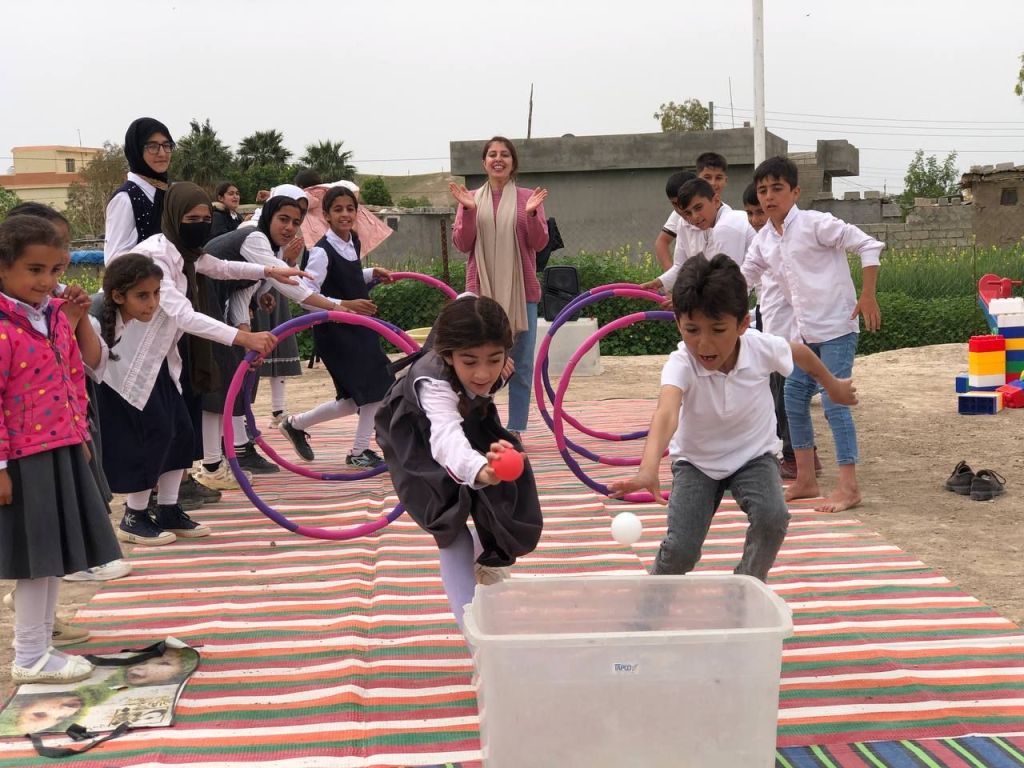
Picture: Activities with Yazidi Children in one of the camps
In response to this crisis, on International Children’s Day, the children of Khanke camp, one of the many Yazidi camps, stood up to demand their rights. Armed with nothing but markers and determination, they voiced their concerns about their future, their education, and the uncertainty that now surrounds them. These children, who have already endured so much, refuse to let go of their hope for a better life.
For the Yazidis, one day is not enough to highlight the basic rights that have long been denied to them. Recognizing this, Wadi and its partners have declared the entire month of June as Children’s Rights Month. They are committed to supporting initiatives that amplify the voices of these students, ensuring that their demand for education and a secure future does not go unheard.
The world must listen to the Yazidi children, who are asking for nothing more than the opportunity to learn and grow, even in the face of adversity. Their resilience is inspiring, but it is time for the global community to take action and ensure that these children are not forgotten in their pursuit of fundamental human rights.
In the Spotlight

When the teams were playing with the children in the play bus, Muhammad was standing near the playground, shying away from participating and murmuring to himself, “I’m a cleric, I’m a Muslim cleric” The teams approached him and slowly introduced him to the games. He started to play and tried all the games. While playing, he kept repeating, I’m a cleric. I will pray for all of you. My prayers are all accepted because I read the Quran. I’m an Islamic cleric. In Kurdish culture, there is a belief that everything from children or medically insane humans is accepted. This is due to their innocence and harmlessness that led people to believe their prayers are always accepted. Muhammad heard from his family and friends that his prayers were accepted, and many people asked him to pray for them. Which leads him to believe he’s a cleric.

She was born disabled because her mother had one child every year and her parents were cousins. His younger sister, 12-year-old Azhine, had dropped out of school to help her mother raise Ashna. She constantly pulled and carried her wheelchair and took care of her. Unaware that her childhood was taken from her, and that she gave up her right of education, to take on the responsibility of protecting her disabled sister.

He loved to play football but nobody played with him. He was 20 years old. Although he loved children, the children said that he raised all the babies in the village, hugging them and rocking them to sleep. While playing, He had a two years old little girl in his arms taking care of her and watching her play.
This project is supported by the
 Wadi
Wadi 
