
For more than two decades, Wadi and its partners have worked persistently to combat Female Genital Mutilation (FGM) and to support women affected by this harmful practice in their efforts to lead healthier and more dignified lives.
While significant progress has been made, FGM has not yet been eliminated in the Kurdistan Region of Iraq.
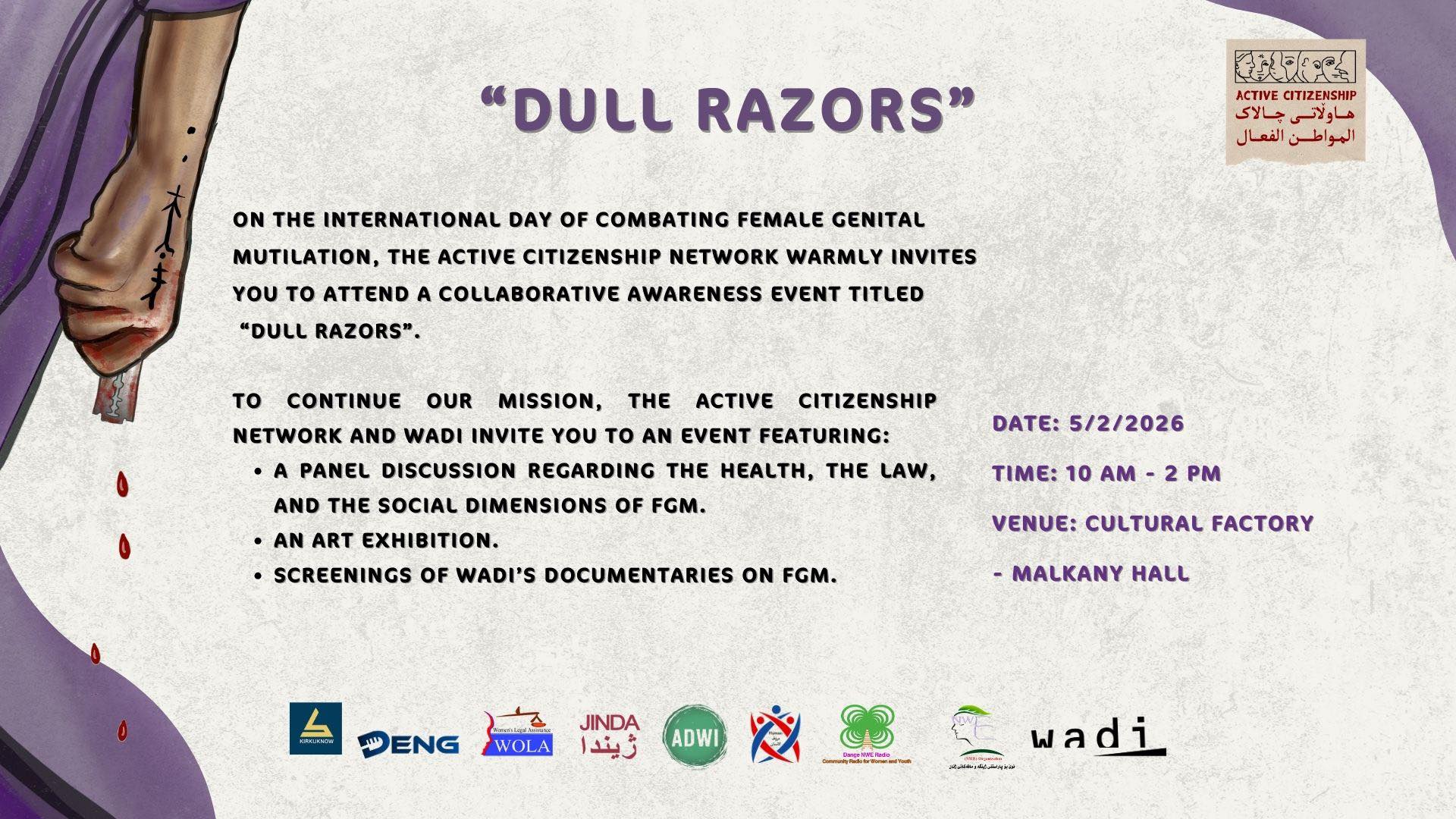
𝙊𝙣 𝙁𝙚𝙗𝙧𝙪𝙖𝙧𝙮 5𝙩𝙝, 2026, a panel of experts and activists will conduct an in-depth discussion on the current state of FGM, as well as screenings of Wadi’s documentary films on the subject, and an art exhibition.
In 2025, Awareness and Development for Women and Children in Iraq (ADWI) documented 77 accounts of FGM among girls under the age of 10 during community seminars. Of these cases, 74 were reported in the Ranya area and 3 in Erbil, underscoring the continued prevalence of FGM in specific locations.
As part of the Citizenship Campaign, which aims to encourage individuals to become active citizens and take responsibility within their communities, this panel discussion addresses FGM as a deeply rooted social practice that continues to exist in certain areas. Although FGM is legally banned, there are still communities where the practice has not entirely disappeared.
Harmful beliefs and social acceptance of FGM persist in the minds of some people, particularly among older generations, and in some cases even among younger individuals. As long as such beliefs continue to exist, the work to eliminate FGM remains unfinished.
At the same time, thousands of women who have already undergone FGM remain in urgent need of support, especially in terms of health care.
Many affected women have had little to no access to medical services throughout their lives. For them, basic medical examinations and health-related support are not a luxury but a minimum necessity that must be addressed.
From a legal perspective, despite the criminalization of FGM, no cases have yet been brought to court. While the goal is not punitive justice, the absence of legal cases reflects ongoing barriers to reporting and legal accountability at the community level.
Furthermore, obtaining reliable and up-to-date data on FGM remains a major challenge. Civil society organizations and local teams continue to work on the ground to understand the real scope of the issue and identify new cases.
This panel aims to shed light on both the progress achieved and the challenges that remain, while reinforcing the importance of community engagement, data collection, health support, and sustained advocacy to fully eliminate FGM and protect future generations.
This program is supported by Netherlands Consulate General in Erbil


