The two model homes, which were designed and furnished by Wadi in collaboration with its partners Nwe and ADWI in Halabja and Kifri, are set to open soon.
By Dominik Metzger, 15.04.2026
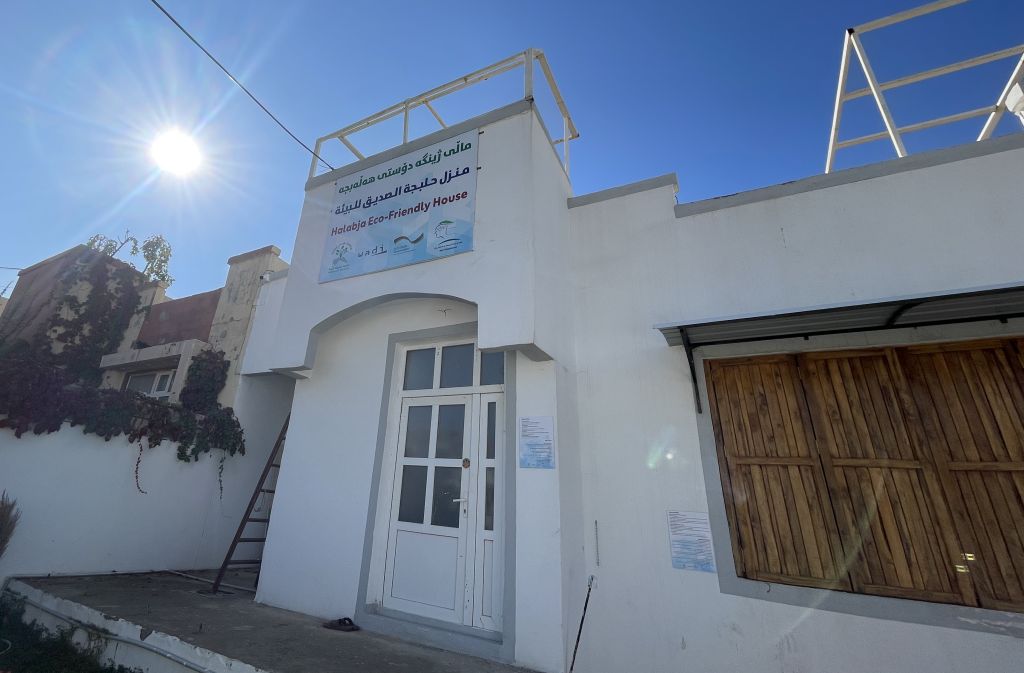
(Picture: Entrance of the Model House in Halabja, Source: Wadi)
While the world’s attention is currently focused on the escalating conflicts in the Middle East, many of the region’s long-term crises are increasingly fading from view. War and political instability dominate the headlines – yet for the people on the ground, the everyday challenges remain. Extreme heat, water scarcity and an unreliable energy supply are already shaping the lives of many families in northern Iraq – and will continue to worsen in the years ahead. It is precisely in times like these that solutions become critical: solutions that do not wait for political stability, but take effect directly in everyday life. Solutions that emerge locally, are easy to understand, and are oriented towards the real conditions on the ground. These are approaches that are not imposed from outside, but grow from the experience of the people themselves – and for that very reason have the potential to endure.
Part of a larger campaign
Among these solutions are the two model houses in Halabja and Kifri, co-financed by the BMZ. They are part of a larger campaign that also includes three recycling centres. Together, these projects aim to develop concrete answers to the pressing questions of resource scarcity, climate adaptation and the sustainable use of materials. Step by step, a network of places is taking shape – places where not only construction and production take place, but above all where learning, experimentation and the sharing of knowledge happen. The model houses were conceived as demonstration buildings for climate-adapted construction. But they have long since become more than that. They are places where it becomes visible how much can be achieved with simple means – when knowledge is made accessible and people begin to take solutions into their own hands. It is not about technological perfection, but about well-considered, practical approaches: houses that remain liveable even in extreme heat, that handle water carefully, and that are less dependent on an often unreliable energy supply.


In Halabja, the first of the two sites, many of these approaches have now proven themselves in everyday life. Over the past months, the house has become a place that demonstrates how significantly quality of life can be improved through targeted yet simple measures. Feedback from the neighbourhood and from visitors makes clear that the ideas are not only being understood, but also being developed further. That is precisely where the real impact lies: not in the individual building, but in the knowledge that radiates from it. These experiences have fed directly into the second model house in Kifri. From the outset, it was possible to build on what had been learned in Halabja. The concept was further developed, adapted and improved in several areas. The result is not a static project, but a dynamic process that continues to evolve – driven by the people working on it locally.
Both houses are now fully completed in terms of construction. The installations are functioning, the concepts have been tested, and the houses are ready to take on their true role: as open learning spaces for the community. Explanatory posters have also been installed to help visitors understand how the individual solutions work and how they can be implemented in their own homes. The houses invite people to ask questions, try things out and develop their own ideas.
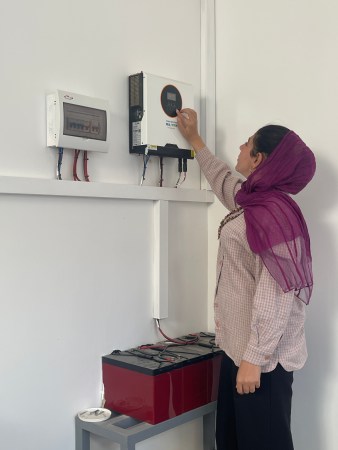
(Batteries to store the solar energy)
At the same time, the current situation in the region is making its direct impact on the project felt. The planned inauguration events in Halabja and Kifri had to be postponed due to the tense security situation. What was intended as a community opening with the local population requires more time and patience under current circumstances. All the greater, then, is the anticipation of the moment when the doors can officially be opened. When school classes walk through the rooms, neighbourhoods come together, and conversations begin about how these approaches can be carried forward, the houses will unfold their full potential.
Women led projects
The fact that both the model houses and the recycling centres are led by women is of particular significance. In a region where women frequently face structural barriers, they are here taking responsibility for concrete solutions and actively shaping the future of their communities. Their work is emblematic of a development becoming visible in many parts of the region: change is increasingly emerging from the ground up – pragmatic, community-driven and closely aligned with people’s real needs.
At a time when major political solutions often seem distant and uncertainty shapes daily life, projects like the model houses in Halabja and Kifri demonstrate that change is nevertheless possible. They show that resilience is not abstract, but begins in very concrete terms – with a house that provides shelter from the heat, with a place where knowledge is shared, and with people who take responsibility.
This project is supported by the German Ministry for Development Cooperation