
Shokh Mohammad from Wadi e. V. talks about her work in the Kurdistan Region of Iraq and the fight against female genital mutilation.
By Jasmin Arémi, Mena-Watch, 16.05.2026
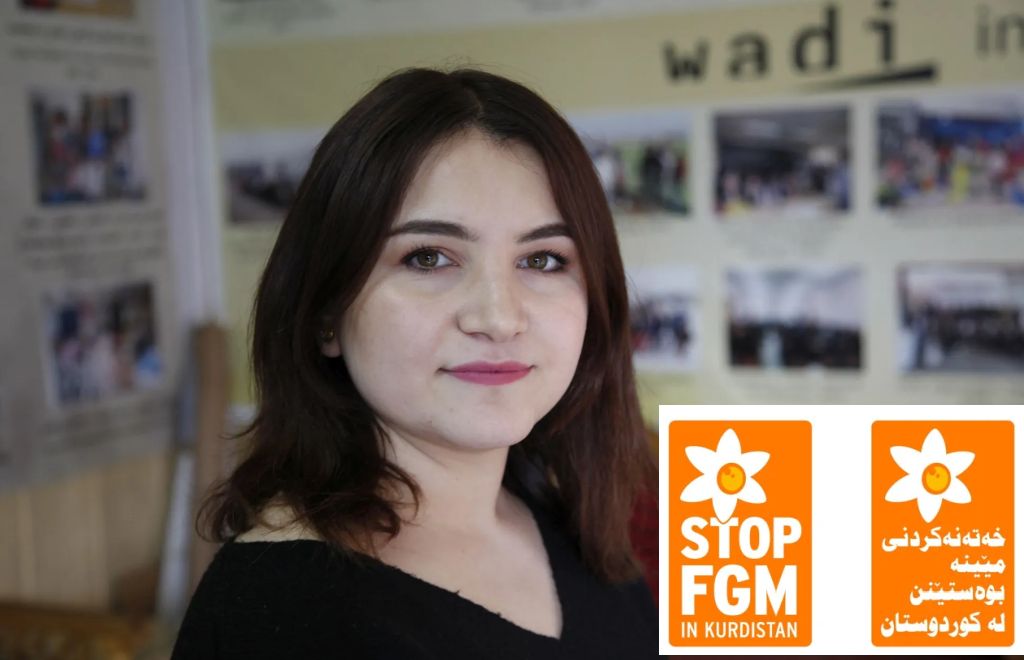
(Picture: Shokh Mohammad, Source Wadi)
In the Autonomous Region of Kurdistan in Iraq, the practice of female genital mutilation (FGM) remains a reality. Although the figures are falling – partly due to legislation passed and a social attitude that is slowly changing – FGM nevertheless remains part of a social system deeply rooted in family, religious and cultural structures. Raising awareness about FGM and talking about it therefore means more than just discussing violence against women’s bodies. It is also about community, control, shame and the fear of social exclusion.
Shokh Mohammad knows these dynamics all too well. “My name is Shokh Mohammad, I am 31 years old,” she says at the start of the conversation. She has been working for Wadi e. V. since 2015, a German-Iraqi organisation that has been active in northern Iraq since 1993. The focus was initially on humanitarian aid, development work and support for women and children in crisis regions.
Religious and social pressure
The issue of FGM arose from an observation that initially seemed insignificant. In the rural areas of the Kurdish Autonomous Region, many girls were missing from nursery schools. Research eventually revealed that these girls were being prepared for the practice of FGM.
The NGO’s initial investigations revealed just how deeply the practice was embedded in society. In some villages, almost all girls were affected. In the Garmian region (in the south-east of the Kurdish Autonomous Region), the rate was as high as 80 per cent. Later, the Ministry of Health of the Kurdistan Autonomous Region also confirmed a prevalence of 42 per cent, although this figure is likely to be an underestimate. This is because FGM is traditionally not discussed, and the procedures take place in secret.
The procedure usually takes place within the context of close family and social ties and is closely linked to local social pressure. The fact that it can be discussed publicly at all today is the result of years of political work. Wadi raised awareness of the issue, collected data, organised campaigns and increased pressure on policymakers. In 2011, FGM was finally banned by law. At the same time, the practice continues, particularly in remote rural areas.
FGM encompasses various forms of female genital mutilation. The World Health Organisation distinguishes between four types. These range from the partial or complete removal of the clitoris and clitoral hood, to procedures involving the labia minora, to the narrowing of the vaginal opening or other harmful and injurious practices. In the areas studied, types I and II are particularly prevalent.
The procedures are often downplayed, even though the health consequences are serious. They lead to bleeding, infections, chronic pain and complications during childbirth. The psychological consequences are equally profound, often resulting in severe trauma. Particularly destructive is the damage to trust in those closest to the victim – mothers, grandmothers or aunts – who usually accompany this violence and initiate it themselves. The injury thus becomes part of family normality. Many victims therefore suffer from anxiety and trauma. Their own bodies become a place of remembrance for an experience that is never fully resolved.
The reasons behind the practice are complex and, at the same time, contradictory. Religious beliefs play a part, as do traditional notions of purity and patriarchal control mechanisms. Above all, however, there is social pressure within communities where FGM is still regarded as a prerequisite for social acceptance. Consequently, it is often not individual conviction that is the primary factor, but the fear of being excluded.
Tangible change
And yet, things are changing. Younger women in particular are increasingly rejecting the practice, not least because many have experienced it themselves and are aware of the consequences. This generational shift in experience is central to Wadi’s work. The organisation focuses on long-term education, dialogue and a presence within the communities. Social workers and lawyers regularly travel to rural areas to discuss health risks, legal consequences and women’s rights. This is not just about the practice of FGM itself, but about a broader understanding of violence and self-determination.
The so-called ‘FGM-free villages’ represent a significant success. Following intensive collaboration, twelve communities have publicly committed to abandoning the practice – and have made this commitment visible. This process was only made possible through months of trust-building. Shokh describes how this change is having an impact using a remarkably simple mechanism of social dynamics: » When some communities saw that their neighbouring villages had discussed the issue and that there were no further problems, they contacted us again.” When it becomes clear that change is possible without destroying social cohesion, things begin to shift.
The organisation therefore also works with religious authorities and state institutions, seeking to secure clear stances against FGM. This includes the Ministry of Religious Affairs as well as local authorities. At the same time, international support remains crucial at the political, financial and public levels. Today, the programme is entering a new phase. Whilst prevention and awareness-raising are showing initial success, the focus is increasingly shifting towards supporting affected women. This is because many live with long-term physical and psychological consequences and require medical and psychosocial support.


