
On the twelfth anniversary of the genocide committed by the Islamic State (IS) against the Yazidis, which began on August 3, 2014, Wadi staff member Basma Aldikhi discusses the current situation of the survivors in an interview with Isis Eligbali.
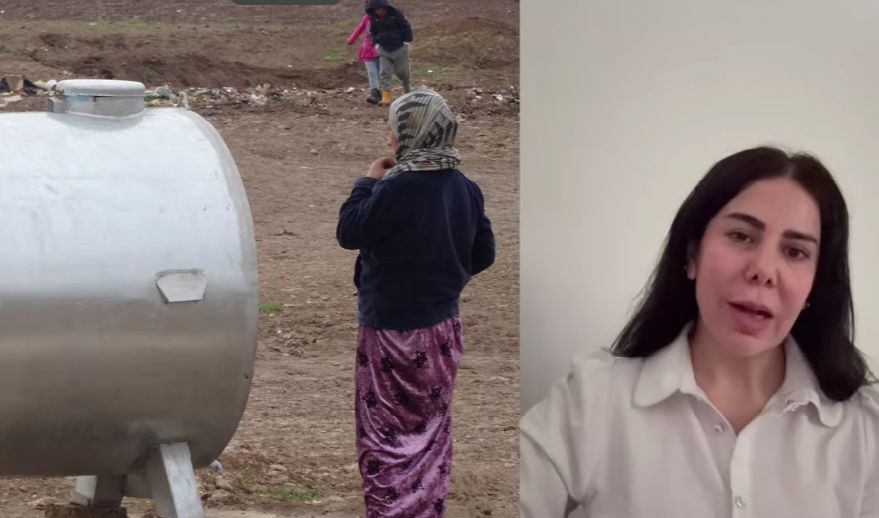
Our colleague Basma Aldikhi is a Yazidi activist and has been working with survivors of the genocide at Wadi e. V. since 2014. She is also a co-author of various reports on the continuing catastrophic situation in the camps for internally displaced persons in Kurdish Iraqi-Kurdistan.
Basma reports that the situation has worsened once again in recent years, particularly following the withdrawal of international aid organizations, and that many camp residents are now contemplating suicide. For most, a return to the Sinjar Mountains—which were captured by ISIS in 2014—is unthinkable. Insecurity persists there, and there is virtually no infrastructure or economic prospects.
While the fate of the Yazidis once dominated the global media, they are now increasingly being forgotten, even though the consequences of the genocide remain a daily reality for them. Of the more than 6,000 girls and women abducted by ISIS at that time—who were subjected to systematic sexual abuse—only about 3,500 have returned so far. There is still no trace of the others.
Basma thus concludes that if the situation does not change, ISIS will likely have prevailed in the long run, because the Yazidi community would then be destroyed. Meanwhile, Yazidi refugees from Europe—especially from Germany—are now even being deported back to Iraq, and thus into a life devoid of prospects and hope.
She therefore urges people not to forget the Yazidis, especially in light of the massive cuts to aid. Meanwhile, even schools are having to close due to a lack of funds and teaching staff. Healthcare in the camps has also been reduced to a minimum.
Here is the full interview:
Overall, then, the situation has continued to deteriorate in recent years and, if it does not change, threatens to become even more catastrophic.
In 2024, we published, together with Pro Asyl, a comprehensive analysis of the situation of the Yazidis in Iraq and the consequences that the genocide has had on this group.
Among other things, it states:
“The report also addresses the Yazidis as a group whose very foundations of life were systematically destroyed—and that is what genocide is all about. This distinguishes them from many others from the Middle East who are fleeing war and destruction: The Islamic State sought not only to exterminate Yazidis, but to eradicate Yazidi existence itself. Thus, with every deportation, the fear grows that not only are individuals being forcibly torn from their new home and sent into an uncertain future, but that the collective existence of the Yazidis is also under threat here.”


