
In an interview with Mena-Watch, Bakhan Jamal from our partner organization ADWI discusses her work and addresses issues within Kurdish society. She also explains why sustainable change can only be achieved in collaboration with local people—and why short-term funding approaches often stand in the way of this work.
Jasmin Arémi (JA) from Mena-Watch: Ms. Jamal, could you briefly introduce yourself and your work for ADWI and Wadi?
Bakhan Jamal (BJ): I started at Wadi as a translator and later worked as a supervisor and project coordinator, among other roles. A key principle of Wadi is to hand over successful projects to local organizations on a long-term basis. For example, the play buses—which initially operated in Germian and later in Ranya and Erbil—were handed over to the local organization ADWI in 2019. ADWI stands for “Awareness and Development Organization for Women and Children in Iraq.”
Today, I am the project coordinator for ADWI and continue to work with Wadi as a supervisor. Our teams come from the towns and regions where they operate. They know the people, the local conditions, and the appropriate way to communicate with one another. This knowledge and the trust built up over the years are crucial to our work.
JA: What does active civic engagement mean to you personally?
BJ: Many people initially take a passive stance toward social problems. They talk about them and complain, but rarely try to bring about change themselves. For me, active civic engagement means taking control of one’s own life again, responding to problems in one’s immediate surroundings, and seeing oneself as part of social change.
In Iraq, there is a deep divide between state and non-state actors, between the population and the government. This has a lot to do with people’s historical experiences. After the dictatorships and the violence they have endured, many view state institutions, the police, or other officials not as allies, but as adversaries. Even when a regime changes, perceptions of power and government do not automatically change. It is difficult to develop trust in institutions that people have long had to fear. That is why campaigns to strengthen civil society are so essential. They can show people that they can be part of a discussion, a network, and ultimately, change.
JA: Why is it important to develop change together with local people?
BJ: A project has a set start and end date. But social change doesn’t follow that kind of timeline. You can’t change mindsets or traditions that have developed over generations within a one- or two-year project. People need to understand why an issue matters to them and take ownership of the change themselves. That’s why campaigns must be developed with them, by them, and for them.
Female Genital Mutilation
Our campaign against female genital mutilation—FGM for short—is a clear example of this. When Wadi began this work, FGM was very widespread in parts of society and, at the same time, a topic that was rarely discussed publicly. To change this, women, midwives, mullahs, experts, and the media had to be involved.
Watch the full interview here:
Today, television programs and social media openly discuss whether people support or oppose FGM. The very fact that this debate is taking place on public platforms would have been almost unimaginable in the past. For this to happen, people had to make the issue their own. It had to be discussed in their own language, connected to their experiences, and championed by people from their own communities. A project imposed from the outside would not have achieved this.
JA: What role does cooperation between the public and government institutions play in this?
BJ: We work with a wide variety of segments of society: with citizens and civil society initiatives, but also with government agencies, the police, hospitals, and local governments. Many public officials come from the affected communities themselves and want to help solve their problems. Often, the only thing missing is a connection between the parties involved. A central task of civil society is to bring both sides together and help them recognize their shared interests.
As a civil society organization, we cannot offer a separate project for every problem. But through contacts, working groups, and networks, we can empower people to communicate and collaborate with one another on their own in the future. I see this as one of our central tasks. Even after many years in this field, I’m constantly surprised by how many government programs, regulations, and responsibilities exist that hardly anyone knows about. How, then, is someone who doesn’t deal with these structures professionally—and who is primarily concerned with providing for their family—supposed to find out about them?
JA: How do you achieve long-term change in your work despite short-term funding?
BJ: One of Wadi’s particular strengths is its long-term perspective. It’s not just about starting a project, completing it, and then moving on to the next one, because social change doesn’t happen within a year or two. It takes ten, fifteen, or twenty years. Wadi has been working in Iraqi Kurdistan for more than three decades. Trust and change arise through many projects that build on one another and by responding to the needs of society—not just the requirements of donors.
For organizations, however, it is difficult to reconcile the interests of funders with what people on the ground actually need. International funders often do not know the regions where we work firsthand. Furthermore, their priorities change. An issue may be the focus of international attention for a while and then, shortly thereafter, be considered outdated.
Environmental Protection
JA: Another important issue is environmental protection. How do people respond to projects such as recycling centers or climate-adapted model homes?
BJ: Environmental issues have become a central part of our work because they affect everyone. In the summer, households throughout Iraqi Kurdistan suffer from water shortages. Everyone experiences the consequences of the environmental and climate crisis in their daily lives. Water has become a topic that can instantly spark a conversation with practically anyone.
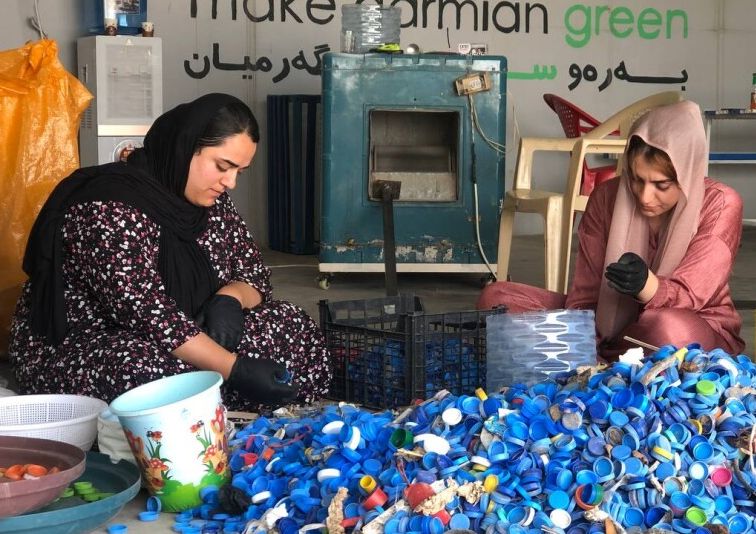
One of the first recycling projects in Iraqi Kurdistan was launched by Wadi in Halabja. Plastic waste litters many streets, neighborhoods, and landscapes, but for a long time, hardly anyone thought about recycling. People complain about the problem and often wait for a more powerful authority to solve it for them. We, on the other hand, try to develop small-scale, realistic models that communities can implement on their own.
Halabja is a special place in this regard. The chemical attack by Saddam’s regime in 1988 not only affected the population but also caused severe environmental damage. The recycling center began as a local initiative to collect and recycle plastic. Since there were neither suitable machines nor an established collection system, we had to figure out a lot on our own: What technology is suitable? How do you organize pickups? Which government agencies and companies do you need to work with? That takes time. Today, the center is a successful—albeit still challenging—project.
Another example is the model homes in Halabja and Kifri. They demonstrate how a typical home in Iraqi Kurdistan can be designed to be more climate- and environmentally friendly. This includes green roofs, thermal insulation, solar technology, and the reuse of graywater. Some approaches build on older ways of life. In the past, houses and courtyards were often more heavily landscaped; with the growth of cities and the construction of increasingly large residential complexes, much of this was lost. The houses take into account the different conditions of the two locations.
Children’s and Women’s Rights
JA: How do you reach children with the play bus and teach them about their rights?
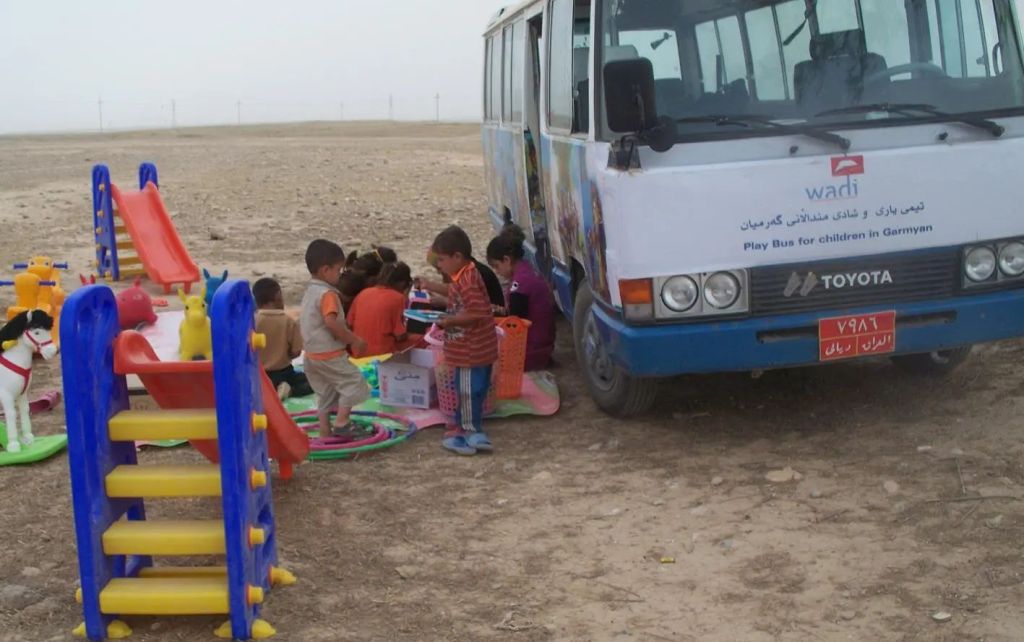
BJ: The play bus is equipped with toys and materials and travels to children in villages, neighborhoods, and camps. To start a conversation with children, you first need an open and safe space. You have to earn their trust instead of treating them like little adults. Play is a wonderful way to do that.
For some children in remote villages, it’s the first time they’ve played with real toys or had adults outside their family pay attention to them in a safe environment. At first, our staff members play with them. Then conversations arise about their daily lives, their worries, and their rights. Often, children approach us even before such a discussion has begun.
Women need to know that the violence they experience is not normal and is not their own fault.
Once, as part of the “No to Violence” campaign, we were working at a school. Children asked us, “Why are you so kind to us? Our teacher doesn’t treat us that way. Can you talk to him, too?” Comments like these were one of the reasons we began to involve not only children but also teachers, school administrators, and parents in our work toward violence-free schools. Children are often overlooked in their families and in society. There are very few spaces where their views are taken seriously. We want to show them that they are people with their own rights, needs, and ideas. After all, they are the future of their community.
JA: What has been your experience in raising awareness about women’s and youth rights?
BJ: Our teams receive legal training so they can respond appropriately to the problems people bring to their attention. We also collaborate with a legal aid organization in Sulaimaniyya. In our seminars, we provide information on topics such as laws against domestic violence and FGM, children’s rights, and digital abuse and dangers on social media. For many women, this is the first time these issues have been addressed as legal matters. After the events, they often approach our staff members in confidence, asking for advice or inquiring about their options in the event of a separation or following an act of violence. Our teams provide them with phone numbers and, if necessary, refer them to counseling centers.
Going to the police is still a significant hurdle, especially for women. Even the mere presence of a woman at a police station can damage her reputation. On top of that, police stations do not always treat women with respect or offer them support. You can feel like a suspect there even before you’ve had a chance to explain what happened. That’s why we try to accompany women or at least show them who they can turn to. At the same time, we’ve offered training for police officers on how to handle cases of domestic violence. Such initiatives are vital.
Women need to know that the violence they experience is not normal and is not their own fault. Rights are of no use to anyone if those affected are unaware of them. That is why laws must be explained publicly—including on social media, which plays a major role for younger people. At the same time, police officers, government officials, and other responsible parties need training so that they do not judge people seeking help, but instead treat them with dignity.


